Music Theory
Music theory is fundamental for musicians to comprehend the structure and relationships between scales and chords. It provides the necessary framework to understand how melodies and harmonies interact, enabling musicians to create and interpret music with greater sophistication. Furthermore, a solid grasp of music theory is indispensable for those preparing to take graded music exams, as these assessments require knowledge of notation, key signatures, intervals, and chord progressions. Mastery of theory not only supports technical proficiency but also enhances creative expression and improvisation skills, making it an essential component of any comprehensive musical education.
-
Mike began his musical education at the age of 5 when he started learning piano and trumpet at school. He achieved grade 8 in both by the age of 14 and an advanced performing certificate in trumpet aged 17. Mike performed for several years with the National Children’s Orchestra at venues such as the Barbican and the Royal Albert Hall. His orchestral journey continued with the East Sussex Youth Orchestra where he was fortunate to play in many prestigious venues across Europe.
Whilst at college Mike achieved grade 8 in singing and attended the Junior Royal College of Music studying trumpet and percussion, achieving grade 8 in the latter shortly after.
Mike then attended Trinity College of Music where he gained both a BMus Hons degree and postgraduate diploma in classical singing.
He has sung bass for the TCM Chamber Choir, the choir at the Royal Hospital Chelsea and the BBC Symphony Chorus. Solo performances include
Mendelssohn’s Elijah
Stainer’s Crucifixion
Mozart Requiem
Fauré Requiem
Menotti’s opera The Telephone.
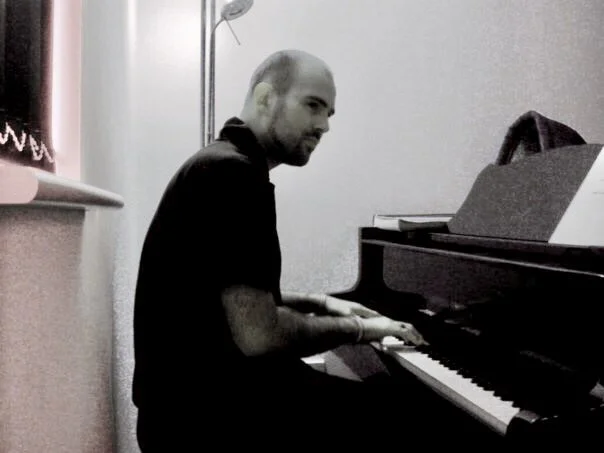
As a pianist Mike’s performances include
Little Shop of Horrors
Copacabana
Les Miserables and
West Side Story
Mike has performed many continuo performances in various concerts across the South East for Pro Musica and Sussex Symphony Orchestra.
He has been playing with the ceilidh band Licence to Ceilidh for 17 years.
He occasionally dabbles as a church organist too.
As a teacher Mike is very flexible in his approach. Whether it be studying for grades or learning popular songs the emphasis is on making it fun alongside introducing musical theory.
“I can’t say enough good things about Mike, my son’s piano teacher! From the moment he started lessons with him, it was clear that Mike is a brilliant teacher. Not only does he have an impressive depth of musical knowledge, but his ability to connect with children is remarkable.
Mike is patient, kind, and understanding. He knows exactly how to keep my son engaged and excited about learning. He tailors his lessons to my son’s unique pace and interests, making each lesson feel fun.
What I appreciate about Mike is his ability to balance structure and creativity. He provides clear, step-by-step guidance while encouraging my son to express himself and explore music in his own way. I couldn’t ask for a better teacher, and I’m so grateful for my son’s progress under his guidance. I highly recommend Mike to anyone looking for a talented and genuinely caring piano teacher!”